About this episode
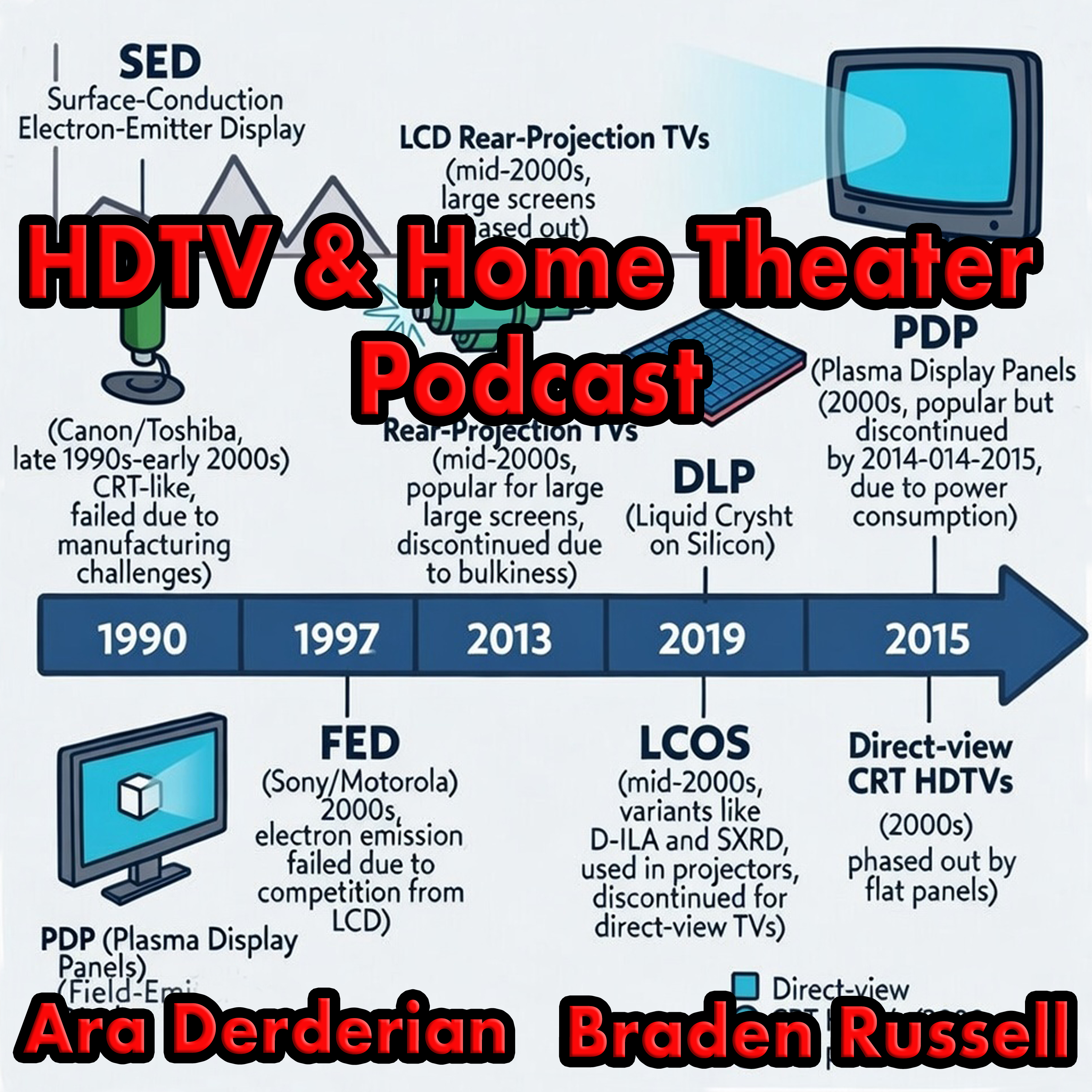
On today's show we look at HDTV Display Technologies that are no longer with us. Some had a short run and some never made it to the market. We also read your emails and take a look at the week's news. News: LG pulls the plug on 8K OLED and 8K LCD TVs Apple's home hub could finally arrive this spring with a rather unique design Roku is Testing a New Home Screen With A New Look Google Home update brings more automation controls HDTV Display Technologies That Are No Longer With Us Over the 21 years we have been doing the show we have seen numerous HDTV display technologies come and go. Some never made it to market and some had a good run but were eventually beat out by something better. These technologies competed during the transition from bulky CRTs to flat panels, but most lost out as LCD, later becoming LED-backlit LCD, then OLED, became dominant for reasons like cost, scalability, picture quality improvements, and manufacturing ease. Technologies That Were Proposed/Demonstrated but Never Commercially Released to Consumers SED (Surface-Conduction Electron-Emitter Display)Developed primarily by a Canon and Toshiba joint venture starting in the late 1990s/early 2000s. It was essentially a flat-panel evolution of CRT technology using electron emitters for each pixel, promising CRT-like motion handling, deep blacks, high contrast, fast response times, and low power in a slim form factor. Prototypes were shown around 2005–2007 with impressive demos. Why it didn't make it: Repeated delays due to manufacturing challenges (high production costs, difficulty scaling/vacuum sealing), patent disputes, and aggressive price drops in LCD/plasma panels. Then by 2009–2010, LCD had become too dominant and cheap; Canon officially froze consumer SED development in 2010, shifting any remaining efforts to niche professional uses. FED (Field-Emission Display)Similar to SED and sometimes grouped together or seen as a precursor/variant. FED used field-emission electron sources (like microtips) for CRT-style performance in a flat panel. Demonstrated in prototypes in the 2000s by companies like Sony and Motorola. Why it didn't make it: Development took too long; manufacturing complexity and yield issues made it unviable. It was overtaken by faster-scaling plasma and then LCD/OLED technologies before reaching mass production. Technologies That Reached the Market but Were Discontinued DLP (Digital Light Processing) Rea